PhD Student in Astrophysics

Victoria Toptun

I study the hot gas in galaxy groups and clusters, using spectral stacking of eROSITA data to see how non-gravitational processes affect the baryon content of systems with masses down to the mass of our own Galaxy.

European Southern Observatory · Munich, Germany

Victoria Toptun at the Paranal Observatory, with the VLT unit telescopes behind
Happy me before observing night on Paranal!

About

I'm a PhD student at European Southern Observatory (ESO), supervised by Paola Popesso and working within the ERC-funded CLEVeR project. My research focuses on galaxy groups, the environment where most galaxies live. Because of their low mass, the baryon content of groups is much more easily affected by non-gravitational processes. How do these processes impact the gas content of groups, and how do they shape the galaxy-halo connection? These are the questions I'm trying to address during my PhD. See what I have achieved so far in the Publications section.

Before Munich I spent six years at Moscow State University, working on intermediate-mass black holes and building the photometry for the large multi-wavelength galaxy catalog RCSEDv2. Even though I'm not actively working on those topics right now, AGN and data science are still among my other scientific interests.

Research

Galaxy Groups and Clusters

CLEVeR: the cluster and group environment as viewed by eROSITA

Galaxy groups are one of the most common environments in the Universe, but at the same time, due to their low mass, they are very sensitive to non-gravitational processes. In our team at ESO, we use observations and simulations together to study very faint groups at the low end of the mass range, which are very hard to reach with individual observations. Over the last four years, from surface-brightness stacking of eFEDS data we concluded that groups have a much more reduced gas content than we would expect, as well as lower gas concentrations. With Magneticum simulations, we not only took a more detailed look at the selection effects of observational samples, but also traced the impact of the assembly history on the gas content.

My part in this project is to use spectral stacking on eRASS1 data for optically selected samples to reach the spectra of low-mass groups. Modeling these X-ray spectra gives the temperature of the hot gas, which is in turn one of the direct proxies of halo mass. With this in hand, I first investigated how the mass-temperature relation evolves toward the low-mass end. In parallel, I applied my stacking procedure to mock X-ray data from the Magneticum simulation, to make sure it reproduces the original properties of the hot gas. Then I traced how the brightest central galaxy in a group is connected to its halo, which is closely tied to the interplay between stellar feedback in the single-galaxy regime and AGN feedback in the cluster regime. Now I'm actively working on a closer look at the centers of galaxy groups: stay tuned for new results by the end of 2026!
2023 - present
Galaxies

Surveys: EMPOWER, ChANGES and RCSEDv2

EMPOWER is a VLT/KMOS integral-field survey. For now I've contributed as a rotating member of its steering committee and as a visitor-mode observer, but I plan to be involved in scientific projects in the future.

For the 4MOST ChANGES survey I worked on selecting the parent sample, which led into this recent paper.

For RCSEDv2 I assembled and calibrated the photometry and built the database, which gave me experience with big data in astronomy, databases and the virtual observatory. The photometric-calibration questions it raised also led to my master's paper.

2019 - present
Black holes

Search for intermediate-mass black holes

The topic of my master's thesis. The mechanisms of growth of supermassive black holes are still unclear: they may grow from massive seeds (105-106 M☉) or from low-mass ones (~100 M☉), and the second route should leave behind a population of intermediate-mass black holes (102-105 M☉).

Fitting spectra from the SDSS survey, we selected a sample of IMBH candidates and confirmed their AGN nature with X-rays. My main job was the X-ray analysis: taking optically selected candidates and confirming the active nucleus from its X-ray emission, then measuring its luminosity and accretion rate. This built a larger sample of bona-fide IMBHs and low-mass supermassive black holes (<106 M☉), using our own XMM-Newton, Chandra and Swift observations together with public archives. I also helped with the photometric decomposition of the host galaxies. Part of this work led to a paper on one peculiar source with a very low accretion rate, to which I contributed as a co-author and was responsible for all of the X-ray analysis.

2017 - 2023

Publications

live from SciX
  1. First author
  2. 2026
    The stellar-to-halo mass relation of central galaxies across three orders of halo mass
    Toptun, Victoria, Popesso, Paola, Marini, Ilaria, Vladutescu-Zopp, Stephan, Dolag, Klaus, Behroozi, Peter, +6 more
    Astronomy and Astrophysics
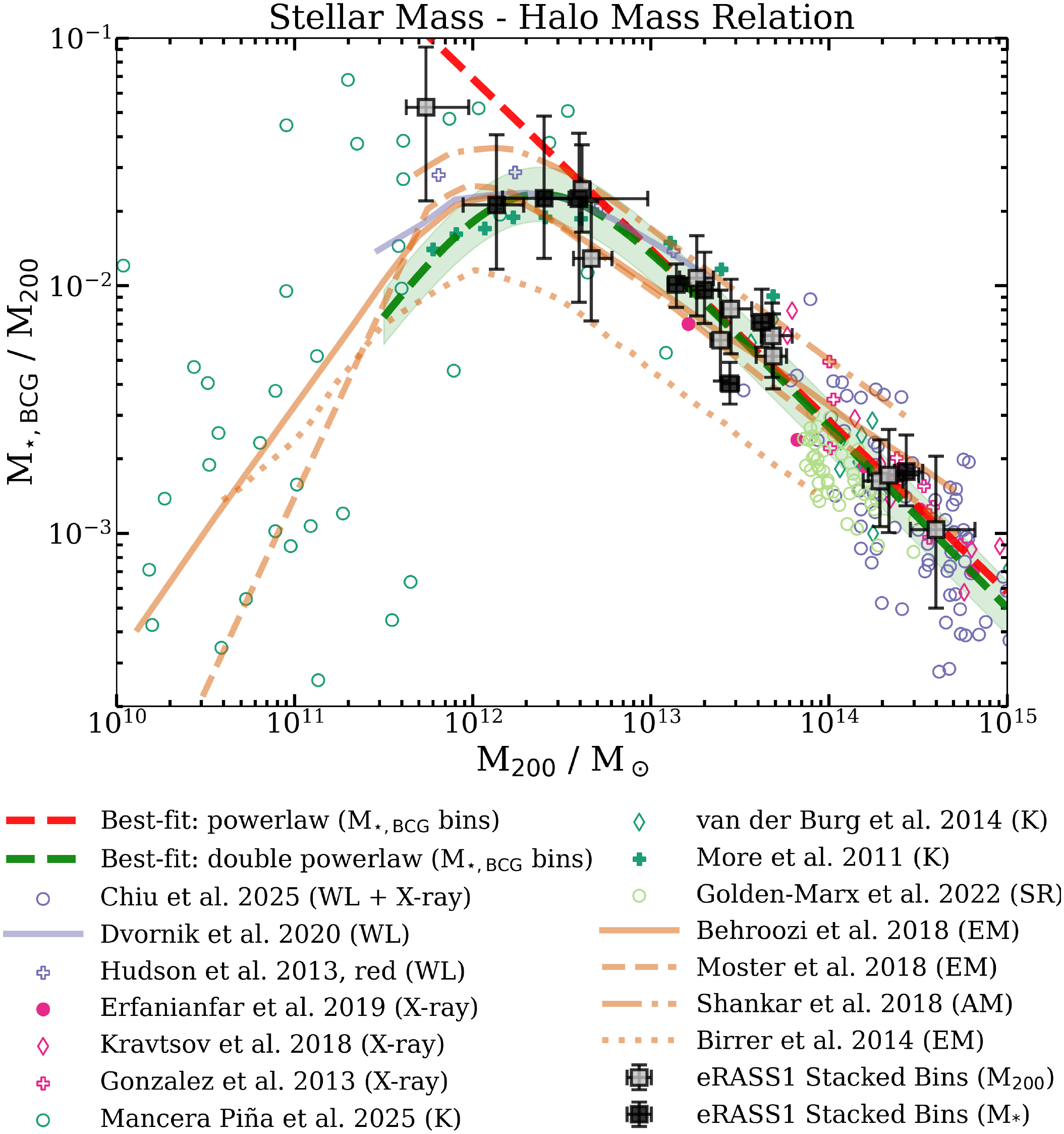
    BCG stellar-to-halo mass ratio as a function of halo mass. Best-fit relations are shown as dashed green and red lines; the shaded region indicates the 1σ uncertainty of the double power-law best-fit relation. Literature measurements are color-coded by halo mass estimation method as indicated in the legend: violet for WL, red for X-ray, green for kinematical and dynamical studies (K), and light green for scaling relations (SR); for the literature data, filled points indicate stacking results, while empty points show results for individual sources. Orange lines correspond to semi-analytical predictions from abundance matching (AM) and empirical modeling (EM).
    BCG stellar-to-halo mass ratio as a function of halo mass. Best-fit relations are shown as dashed green and red lines; the shaded region indicates the 1σ uncertainty of the double power-law best-fit relation. Literature measurements are color-coded by halo mass estimation method as indicated in the legend: violet for WL, red for X-ray, green for kinematical and dynamical studies (K), and light green for scaling relations (SR); for the literature data, filled points indicate stacking results, while empty points show results for individual sources. Orange lines correspond to semi-analytical predictions from abundance matching (AM) and empirical modeling (EM).

    The stellar-to-halo mass relation (SHMR) of central galaxies traces how feedback and gravity regulate star formation across halo mass. The stellar-to-halo mass ratio peaks near 1012-1012.5 M⊙, where stellar and AGN feedback are comparably effective, and declines toward clusters, where AGN feedback and the long cooling times of massive halos quench star formation. X-ray data are one of the most direct tracers of halo mass but very hard to get for low-mass sources, so the peak of the SHMR had only been traced with weak lensing and dynamical modeling.

    Data: I use about 100,000 groups and clusters from the Yang et al. (2007) catalog, covering log M200 from 11.7 to 15.0, with BCG stellar masses from GSWLC-X2.

    Methods: I stack their eRASS1 spectra in bins of BCG stellar mass, get the temperature from spectral modeling, and convert it to halo mass through the mass-temperature relation, which gives the SHMR over the full mass range.

    Result: For the first time, we push the observational SHMR from X-ray data up to the peak masses (1012-1012.5 M⊙), over the widest mass range ever probed, confirming the predicted connection between the BCG and its dark halo even for the smallest groups.

  3. 2025
    The eROSITA view on the halo mass-temperature relation: From low-mass groups to massive clusters
    Toptun, V., Popesso, P., Marini, I., Dolag, K., Lamer, G., Yang, X., +12 more
    Astronomy and Astrophysics
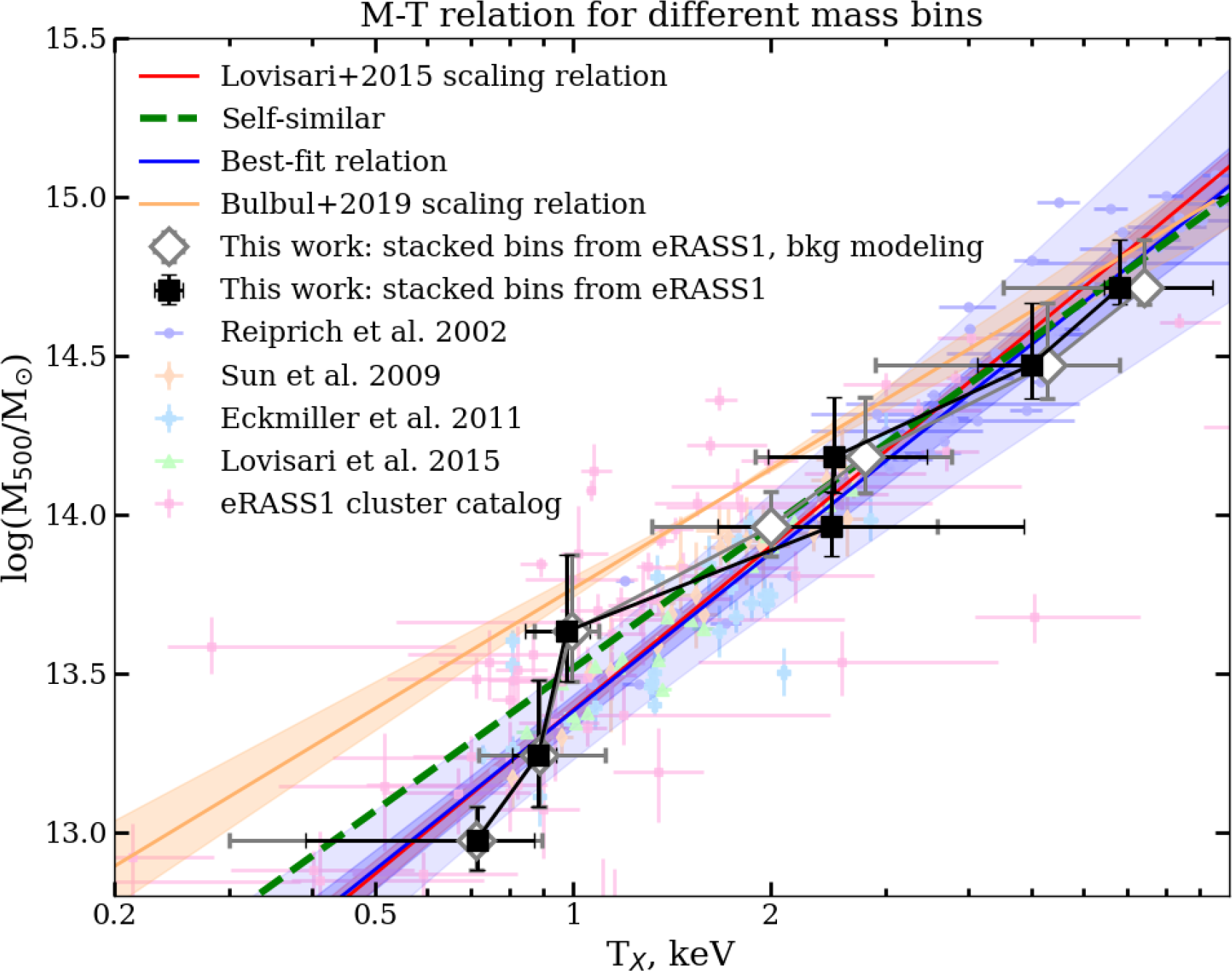
    The mass-temperature relation for galaxy groups and clusters in observations, with mass defined inside R500 as a function of X-ray temperature. Black squares correspond to stacked bins from eRASS1 observations. Open diamonds represent background modeling instead of background subtraction. The red line shows the scaling relation from Lovisari et al. (2015), the orange line represents the relation from Bulbul et al. (2019), and the green dashed line indicates the self-similar model. The blue line corresponds to the best-fit relation. Shaded regions indicate the 1σ and 3σ confidence intervals for the respective relations.
    The mass-temperature relation for galaxy groups and clusters in observations, with mass defined inside R500 as a function of X-ray temperature. Black squares correspond to stacked bins from eRASS1 observations. Open diamonds represent background modeling instead of background subtraction. The red line shows the scaling relation from Lovisari et al. (2015), the orange line represents the relation from Bulbul et al. (2019), and the green dashed line indicates the self-similar model. The blue line corresponds to the best-fit relation. Shaded regions indicate the 1σ and 3σ confidence intervals for the respective relations.

    The mass-temperature relation is one of the ways to study the impact of feedback on halos. Luminosity-based relations depend on many parameters such as emissivity, while the mass-temperature relation is sensitive only to non-gravitational processes and, without them, is expected to follow the self-similar scenario.

    Data: I use about 20,000 galaxy groups and clusters from the optical group catalog of Yang et al. (2007), with the total optical luminosity as the halo mass proxy, in mass bins from 1013 to 1015 M⊙.

    Methods: I stack the eRASS1 spectra of the sources in each mass bin, model the stacks and estimate the temperature.

    Result: We extend the known mass-temperature relation from clusters down to the group mass scale and find no significant deviations from the self-similar scenario, within the statistical errors. So we see no significant heating of the gas on average up to R500. Two possibilities remain: the gas is only pushed out without significant heating, or it is heated by AGN feedback only in the central regions, without affecting the total gas content on average.

  4. 2023
    Color Transformations of Photometric Measurements of Galaxies in Optical and Near-infrared Wide-field Imaging Surveys
    Toptun, Victoria A., Chilingarian, Igor V., Grishin, Kirill A., Katkov, Ivan Yu.
    Publications of the Astronomical Society of the Pacific Color calculator ↗
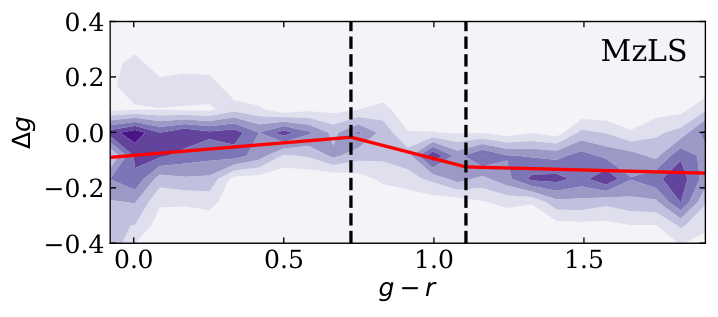
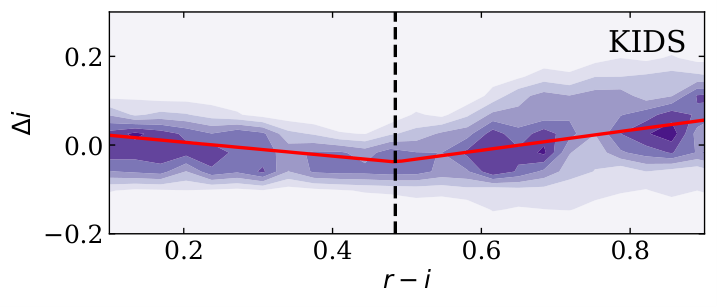
    Example of a piecewise linear regression in the Legacy-MzLS g band (left) and KiDS i band (right). Black dashed lines show the breakdown into linear regression segments. The color indicates the weights. The red line is the fitting result. The Y-axis shows the difference between the correcting band and the corresponding SDSS band, the X-axis shows the color in the correcting survey.Example of a piecewise linear regression in the Legacy-MzLS g band (left) and KiDS i band (right). Black dashed lines show the breakdown into linear regression segments. The color indicates the weights. The red line is the fitting result. The Y-axis shows the difference between the correcting band and the corresponding SDSS band, the X-axis shows the color in the correcting survey.
    Example of a piecewise linear regression in the Legacy-MzLS g band (left) and KiDS i band (right). Black dashed lines show the breakdown into linear regression segments. The color indicates the weights. The red line is the fitting result. The Y-axis shows the difference between the correcting band and the corresponding SDSS band, the X-axis shows the color in the correcting survey.

    Wide-field surveys observe through slightly different photometric systems, with different response curves and different post-processing procedures, and the standard conversions between them are based mostly on point sources, so they are biased for galaxies. This matters when several surveys are combined into one homogeneous photometric catalog, as we needed for the RCSEDv2 project: once all magnitudes are transformed into the same system, we can build consistent spectral energy distributions (SEDs), and use them to select specific types of sources for future studies.

    Data: I use integrated and aperture galaxy photometry from SDSS, DECaLS, BASS, MzLS, DES, DELVE, KiDS, VST ATLAS, UKIDSS, UHS, VHS and VIKING, taking SDSS (optical) and UKIDSS (near-infrared) as the reference.

    Methods: For each survey I fit the magnitude offset from the reference as a function of galaxy color with a density-weighted, piecewise-linear regression, so sparsely populated color ranges are not ignored. I validate the result on the red sequence of k-corrected color-magnitude diagrams.

    Result: You can find color transformations for galaxies between all these surveys, released as Python and IDL code and a web calculator. Comparing DECaLS with DES also revealed systematic problems in DECaLS DR9 photometry of extended galaxies.

  5. 17
    Publications
    without proceedings
    288
    Citations
    9
    h-index
  6. Most cited co-authored
  7. 2026
    The hot gas mass fraction in halos: From Milky Way-like groups to massive clusters
    Popesso, P., Biviano, A., Marini, I., Dolag, K., Vladutescu-Zopp, S., Csizi, B., +18 more
    Astronomy and Astrophysics 64 citations
  8. 2025
    Average X-ray properties of galaxy groups: From Milky Way-like halos to massive clusters
    Popesso, P., Marini, I., Dolag, K., Lamer, G., Csizi, B., Biffi, V., +17 more
    Astronomy and Astrophysics 34 citations
  9. 2024
    Detecting galaxy groups populating the local Universe in the eROSITA era
    Marini, I., Popesso, P., Lamer, G., Dolag, K., Biffi, V., Vladutescu-Zopp, S., +11 more
    Astronomy and Astrophysics 33 citations
  10. 2023
    The volume density of giant low surface brightness galaxies
    Saburova, Anna S., Chilingarian, Igor V., Kulier, Andrea, Galaz, Gaspar, Grishin, Kirill A., Kasparova, Anastasia V., +2 more
    Monthly Notices of the Royal Astronomical Society 29 citations

Background

09.2023 - 09.2027

PhD in Astrophysics (in progress)

European Southern Observatory & LMU Munich

X-ray properties of galaxy groups and clusters with eROSITA. ERC-funded CLEVeR project.
Supervisor: Paola Popesso (ESO)

09.2017 - 06.2023

Joint BSc + MSc

Moscow State University (SAI MSU)

Qualification: Astronomer, Teacher of Astronomy.
Intermediate-mass black holes and the RCSEDv2 galaxy catalogue.
Supervisor: Igor Chilingarian (CfA)

Accepted observing proposals

Principal investigator
  • XMM-Newton AO-24Unveiling the halo properties of optically selected X-ray faint groups
  • XMM-Newton AO-24Photon Index vs Eddington Ratio Relation for Intermediate-Mass Black Holes
Co-investigator
  • XMM-Newton AO-22Expanding a sample of X-ray confirmed intermediate-mass black holes
  • Chandra Cycle 24 GOX-ray confirmation of optically selected IMBH-powered AGN and high-resolution imaging of their host galaxies
  • JWST Cycle-2NIRSpec IFU spectroscopy of the first active binary intermediate-mass black hole and its host galaxy
  • HST Cycle 30Snapshot survey of host galaxies of active 'light-weight' supermassive black holes

Co-author of 7 proposals to XMM-Newton, Chandra, JWST, VLT (MUSE, KMOS, X-Shooter) and HST.

Service & observing

  • 2025 - ...Steering committee member, EMPOWER KMOS Survey
  • 2023 - ...Organizer and Chair, ESO Weekly Journal Club
  • 2026Co-supervisor of a 6-week summer student, 8th ESO Summer Research Programme
  • 2025Selection committee member, ESO Studentship 2025b
  • 2025Scientific Assistant, ESO Observing Programmes Committee P116
  • 2025LOC, conference "Multi-phase, Multi-temperature and Complex"
  • 2023LOC, conference "A Decade of ESO Wide-field Imaging Surveys"
  • 2023LOC, conference "A journey through galactic environments"
At the telescope
  • 2026KMOS, ESO Paranal, visitor observer (9-15 Feb)
  • 2022COSMOS, Cerro Tololo Observatory (28-30 Nov)
  • 2022LCO Magellan Baade, July (remote)

X-ray imaging and spectroscopy

XMM-Newton SASChandra CIAOeROSITA eSASSXSpecSherpaXSelect

Surface photometry

photutils ellipseGalFit1D and 2D decomposition

Virtual observatory

TAP servicesDaCHSTOPCATDS9Aladin

Computing

PythonCC++PostgreSQLLaTeX

Spoken

EnglishRussian

Talks

long 40-minute talks are highlighted

Get in touch

Happy to discuss research, papers, collaborations, seminars, or job opportunities:

victoria.toptun@eso.org